eProofficials

Helm

We built the reporting we could not buy.

Helm is the dashboard we run every client account through. Your numbers are logged daily, not reconstructed at month end — which is why the monthly report can tell you what happened on a Tuesday in the second week and why it mattered.

Most agencies keep account management in a spreadsheet and a memory. That is how a reporting call turns into a story instead of a record.

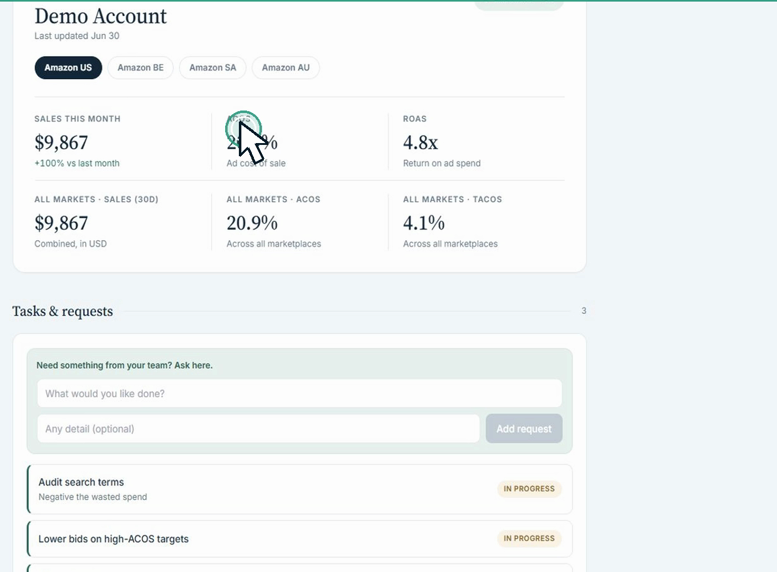
Helm account overview showing sales this month, ACoS, TACoS and ROAS across four marketplaces, with the client's open requests listed underneath
Account overview — this month's sales, ACoS, TACoS and ROAS across every marketplace, with the client's open requests underneath. Demo account; no client data shown.

What it does

Four things, done every day.

Daily tracking, per account

Total sales, orders, ad sales, ad spend, account status and written notes — captured every day rather than pulled together the week a report is due. Multi-marketplace, with each market held in its own currency and rolled up in USD.

The maths runs itself

ACoS, TACoS and ROAS calculated on entry. Day-over-day, week-over-week and month-over-month growth, running averages, best and worst sales days, and the sales and advertising trend behind them. No manual spreadsheet arithmetic, and therefore no spreadsheet arithmetic errors.

A health score per account

Each account carries a 0 to 100 health score in a clear band, with a plain-language written read alongside it — the kind that says "sales up 14% week over week, ACoS improved from 27% to 19%, account healthy" rather than showing you a chart and leaving the interpretation to you.

Alerts before the P&L notices

ACoS spikes, sales drops and accounts that have not been updated all raise an alert automatically. The point of a daily log is not the log. It is that a bad week gets caught on day two.

Health bands

Excellent

Performing above target on both efficiency and growth.

Healthy

On target. Routine optimisation continues.

Needs attention

A metric has moved against us. Named in the next report with a plan.

Critical

Raised immediately, not at month end.

Why we bothered

Account management is usually a black box.

You are asked to trust that work is happening. Helm was built so that trust is not required — the record exists whether or not anyone asks for it.

Reports stop being retrospective fiction

When the numbers were entered on the day, the monthly report is a summary of a record rather than a reconstruction from memory. Those read very differently.

Nothing depends on one person remembering

Role-based access means the account has a documented state, not a keeper. Handover, cover and review all work off the same record.

Every claim we make is checkable

"Evidence before excitement" is easy to write on an about page. Helm is what makes it operationally true — if we cannot show you the entry, we do not make the claim.

Inside Helm

What it looks like.

Every screenshot below is taken from a demo account. No client data is shown.

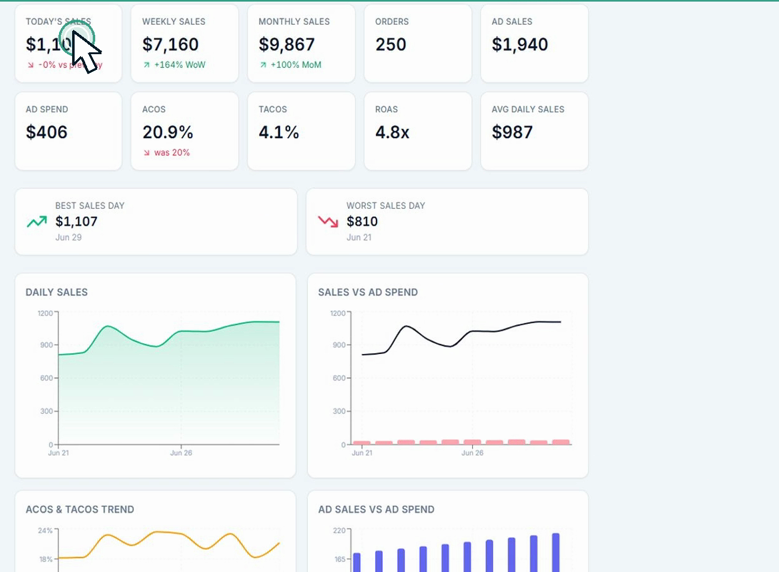
Helm indicator grid showing today's, weekly and monthly sales, orders, ad sales, ad spend, ACoS, TACoS, ROAS and average daily sales, above daily sales and sales-versus-ad-spend charts
The daily indicator set, with best and worst sales day called out, above the charts they come from.
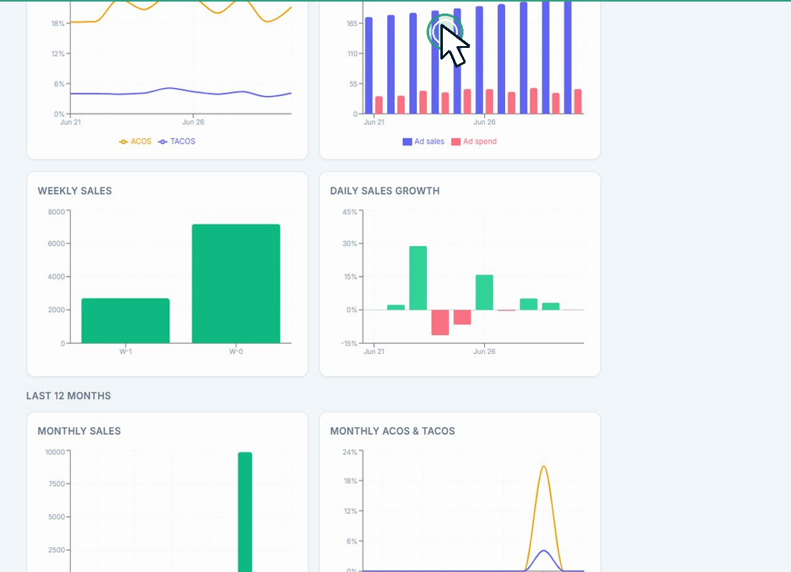
Helm trend view showing ACoS and TACoS plotted together, ad sales against ad spend, weekly sales, daily sales growth, and twelve-month sales and ACoS charts
ACoS and TACoS read together rather than separately, with weekly sales, daily growth and the twelve-month shape underneath.
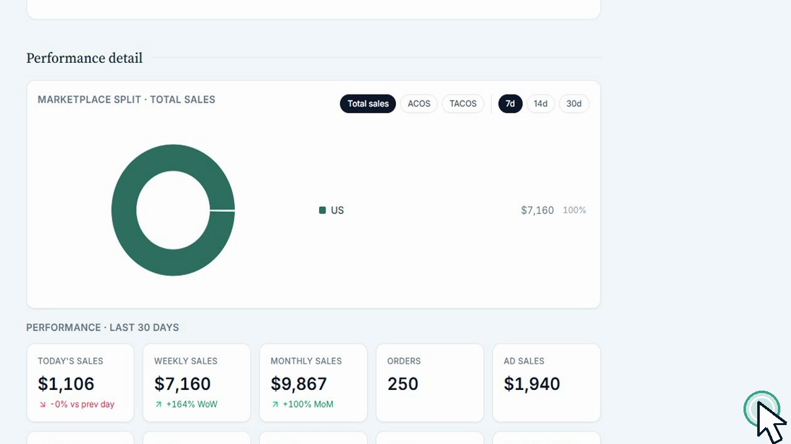
Helm performance detail showing the marketplace split of total sales as a donut chart, with thirty-day sales, orders and ad sales tiles beneath it
Marketplace split and thirty-day performance, so each market can be steered on its own numbers.

Next step

See your account in it.

Every account we take on is set up in Helm from day one. The audit comes first — it tells you whether there is enough on the table to be worth either of our time.